

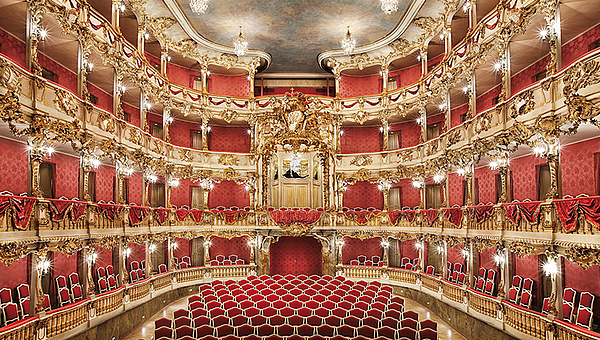
Festive Concert in the Cuvillés-Theatre
Mozart: Piano Concerto in B-flat Major, K. 595
Chopin: Polonaise
Beethoven: Symphony No. 1 in C Major
Grieg: Peer Gynt – Suite
Misora Ozaki - Piano & Residenz-Solisten
Wolfgang Amadeus Mozart completed his final piano concerto—the Piano Concerto in B-flat Major, K. 595—in Vienna in January 1791. The music radiates lightness, serenity, and quiet elegance. At the premiere, Mozart himself sat at the fortepiano; it would be his last public appearance as a pianist. In the finale, a simple, almost song-like melody appears that Mozart later used in his song “Sehnsucht nach dem Frühling” (“Longing for Spring”), with the well-known opening words: “Komm, lieber Mai …” (“Come, dear May…”). There is a special magic in this music—a gentle farewell and at the same time a hopeful anticipation of renewal.
With his Symphony No. 1 in C Major, Ludwig van Beethoven brings fresh energy and bold colors into the concert hall. Even in this early work, the unmistakable spirit of the young composer becomes evident: elegant melodic lines combine with rhythmic vitality and surprising harmonic turns. The symphony sparkles with vitality and already hints at the creative power that would soon make Beethoven one of the greatest symphonists in the history of music.
A few decades later, Frédéric Chopin sits at a piano in a Parisian salon. Under his hands, the polonaise—once a courtly Polish dance—is transformed into a virtuosic and heroic concert piece. The famous Polonaise in A-flat Major, Op. 53 in particular unfolds monumental energy: powerful bass lines, brilliant chords, and a proud, driving rhythm. Contemporary accounts even suggest that Chopin, while composing, imagined armored riders before his eyes—an image that vividly reflects the heroic aura of this music.
The colorful conclusion of the evening is music from Edvard Grieg’s score to Peer Gynt, written for Henrik Ibsen’s famous play. From this work come two of the most beloved soundscapes in the Romantic orchestral repertoire: the lyrical “Morning Mood,” in which the sunrise unfolds in delicate woodwind lines, and the mysterious “In the Hall of the Mountain King,” whose music grows from a quiet motif into a thrilling orchestral whirlwind.
Thus, in the magnificent Cuvilliés Theatre, a musical arc unfolds—from classical elegance through Romantic virtuosity to the colorful imagination of Nordic sound. The result is a festive concert evening full of brilliance, emotion, and musical discovery.
Due to limited places, wheelcair seats can only booked through +49 89 2897 5597 manually.
Festive Concert in the Cuvillés-Theatre
Mozart: Don Giovanni – Overture
Mozart: Symphony No. 38 “Prague”
Beethoven: Piano Concerto No. 3
Dvořák: “From the New World” – Suite
Residenz-Solisten
Gala Concert at the Cuvilliés Theatre – A Musical VIP Experience
The very room tells a story: the golden Rococo of the Cuvilliés Theatre, once the stage for courtly celebrations and grand opera evenings. In this intimate jewel, the concert evening begins with one of the most famous overtures in music history.
Wolfgang Amadeus Mozart – Overture to Don Giovanni
Dark D minor, powerful chords – like the sudden lifting of a curtain. The music floods the hall with almost ominous force, announcing the “Stone Guest,” the mysterious figure who will pass judgment on the seducer at the opera’s end. But almost as soon as this shadow appears, a feverish Allegro erupts: restless, sparkling, full of dramatic energy. In just a few minutes, the entire world of Don Giovanni unfolds: tragedy and comedy, menace and zest for life.
The creation of this piece belongs to the legendary moments of music history. For the Prague premiere in 1787, Mozart composed the overture only the night before. While he worked, his wife Constanze kept him awake with stories and punch. By morning, the score was hastily copied – and that evening the orchestra performed this highly complex work almost entirely at sight. A risky undertaking, yet it became a triumphant opening to the opera.
Mozart – Symphony No. 38 “Prague”
The so-called Prague Symphony is closely linked to Mozart’s special relationship with the city. There, he was celebrated with an enthusiasm rarely experienced in reserved Vienna. “My Praguers understand me,” he is said to have remarked.
Composed in 1787, the symphony reflects this mutual admiration. It omits the customary minuet, consisting of only three movements – unusual for its time. Instead, Mozart unfolds a rich contrapuntal structure and challenges the wind players with exceptional virtuosity. The musicians in Prague were considered the best in Europe, and Mozart composed for them with palpable joy in the challenge. The result is a symphony of brilliant elegance, dramatic energy, and vibrant orchestral color.
Ludwig van Beethoven – Piano Concerto No. 3 in C minor
Beethoven’s Third Piano Concerto opens a new musical world. The key of C minor – the same in which his famous Fifth Symphony would later appear – lends the work a special dramatic intensity. Tension, passion, and almost heroic energy shape this concerto, which premiered in Vienna in 1803.
Here too, an anecdote gives a nearly cinematic image of the evening. Beethoven played the solo part himself but had scarcely found time to fully write down the score. His friend Ignaz von Seyfried, who was to turn the pages, looked at sheets mostly blank – only here and there cryptic marks served as reminders for the composer. While Seyfried nervously tried to keep up, Beethoven performed the concerto from memory with complete confidence.
A program that unites three facets of the Viennese Classical style: Mozart’s dramatic operatic world, his brilliant symphonic writing, and Beethoven’s passionate, forward-looking sound language. An evening that combines history, virtuosity, and emotion in a uniquely atmospheric setting
Due to limited places, wheelcair seats can only booked through +49 89 2897 5597 manually.
Festive Concert in the Cuvillés-Theatre
Mozart: Overture from Don Giovanni
Beethoven: Piano Concerto No. 5, “Emperor”
Beethoven: Symphony No. 3, “Eroica”
Fuyin Liu – Piano & Resident Soloists
The Prague night of 1787 trembled with expectation as the musicians of the National Theatre laid the still-damp, hastily copied sheets of the Don Giovanni overture on their stands. Mozart had only completed the score in the early hours, while his wife Constanze kept him awake with punch and ghost stories—a feat of genius dictated by time itself.
A far more thunderous historical backdrop surrounds Beethoven’s Fifth Piano Concerto, the heroic work in E-flat major forged in 1809 amid the roar of Napoleon’s cannons during the siege of Vienna. It is pure historical paradox: as French artillery shook the city walls and the aristocracy fled in panic, Beethoven, already struggling with profound hearing loss, sought refuge in his brother’s cellar. The name “Emperor,” bestowed by posterity, is an ironic twist: Beethoven did not compose a hymn to the advancing conqueror, but rather erected an unshakable architecture of the human spirit against the destruction outside. In a city that smelled of gunpowder and where fear dictated daily life, he created sounds of imperial vastness, lifting the individual above the chaos of war.
This spirit of resistance to tyranny had already shaped his Third Symphony, the Eroica—a turning point where Viennese Classicism finally shattered its fragile porcelain. Vienna was then a crucible of political hope, eyes fixed on Paris, where a young general named Bonaparte toppled the old order. Beethoven initially saw him as the living embodiment of Enlightenment ideals—until the news of Napoleon’s self-coronation in May 1804 seeped like poison into his vision. The moment when Beethoven erased the dedication on the title page with such force that the paper tore is more than a biographical anecdote—it is the symbol of music discovering its political conscience. In the torn fibers of the manuscript, one can sense the shock of an entire generation, forced to confront that its dreams of freedom had been buried in the mud of the battlefield.
Festive Christmas Concert
J.S. Bach: Overture in B minor
J.S. Bach: Brandenburg Concerto No. 5
Vivaldi: "Winter" from "The Four Seasons"
Corelli: Christmas Concerto
Handel: Concerto grosso
Vivaldi: Flute Concerto "La Notte"
Michael Kofler - Flute MPhil, Rodrigo Belío - Cembalo & Residence-Soloists
The Cuvilliés Theater is one only of the most beautiful and also one of the most important rococo theaters in Europe. In 1753, the hall, decorated entirely in royal purple and gold, with it‘s 14 boxes on 4 floors under Maximilian III. Joseph will be opened. Well-known operas such as Mozart's “Indomeneo” were premiered here. In 1806, Emperor Napoleon attended the opera “Don Giovanni” on the occasion of the inauguration of Bavaria. The Cuvilliés Theater with its “Style rocaille” is an art-historical work of art.
Experience the Residence Soloists in this unique, magnificent environment with a richness of sound that does credit to the masters of classical music and makes their performance a very special listening pleasure.
The Middle Logde is only available per phone-call under: +49 89 2897 5597.
Due to limited places, wheelcair seats can only booked through +49 89 2897 5597 manually.
Festive Christmas Concert
Vivaldi: "Winter" from "The Four Seasons"
J. S. Bach: Double Concerto for Oboe and Violin
Corelli: Christmas Concerto
Handel: Concerto Grosso
Vivaldi: Concerto for Oboe
Tchaikovsky: Highlights from "The Nutcracker" and "Swan Lake"
Tschaikowski: „Nußknacker“ und „Schwanensee“
Karsten Gebhardt - Violin, Giovanni De Angeli – Oboe, Rodrigo Belío - Cembalo & Residence-Soloists
The Cuvilliés Theater is one only of the most beautiful and also one of the most important rococo theaters in Europe. In 1753, the hall, decorated entirely in royal purple and gold, with it‘s 14 boxes on 4 floors under Maximilian III. Joseph will be opened. Well-known operas such as Mozart's “Indomeneo” were premiered here. In 1806, Emperor Napoleon attended the opera “Don Giovanni” on the occasion of the inauguration of Bavaria. The Cuvilliés Theater with its “Style rocaille” is an art-historical work of art.
Experience the Residence Soloists in this unique, magnificent environment with a richness of sound that does credit to the masters of classical music and makes their performance a very special listening pleasure.
The Middle Logde is only available per phone-call under: +49 89 2897 5597.
Due to limited places, wheelcair seats can only booked through +49 89 2897 5597 manually.
Festive New Year Concert
Mozart: Piano Concerto in E-flat major No. 14, K. 449
Gershwin: “Rhapsody in Blue”
Strauss: “Die Fledermaus” – Overture
Strauss: “The Blue Danube” – Waltz
Strauss: “Tritsch-Trasch” – “Pizzicato” & other fast polkas
Frank Fan Ming Ling – Klavier & Residence-Soloists
The Cuvilliés Theater is one only of the most beautiful and also one of the most important rococo theaters in Europe. In 1753, the hall, decorated entirely in royal purple and gold, with it‘s 14 boxes on 4 floors under Maximilian III. Joseph will be opened. Well-known operas such as Mozart's “Indomeneo” were premiered here. In 1806, Emperor Napoleon attended the opera “Don Giovanni” on the occasion of the inauguration of Bavaria. The Cuvilliés Theater with its “Style rocaille” is an art-historical work of art.
Experience the Residence Soloists in this unique, magnificent environment with a richness of sound that does credit to the masters of classical music and makes their performance a very special listening pleasure.
The Middle Logde is only available per phone-call under: +49 89 2897 5597.
Due to limited places, wheelcair seats can only booked through +49 89 2897 5597 manually.
Festive New Year Concert
Mozart: Piano-Concerto E-flat major No.14 K. 449
Gershwin: “Rhapsody in blue”
J.Strauß: “Bat” – Ouverture
J.Strauß: „blue Danube“ – Waltz
J.Strauß: "Tritsch-Trasch" - "Pizzicato" & further Quickpolkas
Frank Fan Ming Ling –piano & Resident-Solists
New years concert: From Mozart to the Viennese Waltz
We invite you on a musical journey that spans the clarity of Viennese Classicism, the jazz-infused colors of American Impressionism, and the lively charm of the Viennese waltz.
The program opens with Wolfgang Amadeus Mozart’s Piano Concerto in E-flat Major, No. 14, KV 449. This work of the high Classical period combines virtuosic piano passages with rich orchestral textures and rhythmic elegance. Mozart achieves a perfect balance between solo brilliance and orchestral dialogue. The lyrical themes, clear melodies, and dynamic interplay between piano and orchestra make the concerto both lively and elegant. Listen closely to the delicate conversations between soloist and ensemble, especially in the first movement, which captivates with lightness and musical wit.
The journey then moves across the Atlantic with George Gershwin’s Rhapsody in Blue, an iconic piece that fuses jazz, classical, and swing. The rhapsody opens with the instantly recognizable clarinet glissando and unfolds with vibrant rhythms and colorful orchestration, evoking the spirit of 1920s New York. Pay attention to the jazzy syncopations and the flowing transitions between lyrical passages and rhythmically driving virtuosity.
The evening concludes with the timeless works of Johann Strauss II. First, the overture to Die Fledermaus sparkles with wit, elegance, and virtuoso orchestral writing, capturing the comic charm of the opera. Next comes the beloved Viennese waltz The Blue Danube, a musical symbol of the Danube and the joyful spirit of Vienna. Finally, Strauss’ lively polkas such as Tritsch-Tratsch and Pizzicato display his mastery of rhythm, melody, and orchestral color, leaving the audience cheerful and exhilarated.
This program offers a rich journey through styles, moods, and eras: from Mozart’s classical refinement, through Gershwin’s American jazz flair, to the carefree joy of the Viennese waltz. Each composition tells its own story, brings emotion vividly to life, and combines technical brilliance with unmistakable character.
Festive Concert in the Cuvillés-Theatre
Bellini: Oboe Concerto
Mozart: Symphony in A major, K. 201
Dvořák: Suite "From the New World"
Rossini: Overture from "The Thieving Magpie"
Brahms: Hungarian Dance No. 5
Strauss: "Die Fledermaus" Overture & Fast Polkas
Strauss: "The Blue Danube" Waltz
Giovanni De Angeli - Oboe & Residence-Soloists
The Cuvilliés Theater is one only of the most beautiful and also one of the most important rococo theaters in Europe. In 1753, the hall, decorated entirely in royal purple and gold, with it‘s 14 boxes on 4 floors under Maximilian III. Joseph will be opened. Well-known operas such as Mozart's “Indomeneo” were premiered here. In 1806, Emperor Napoleon attended the opera “Don Giovanni” on the occasion of the inauguration of Bavaria. The Cuvilliés Theater with its “Style rocaille” is an art-historical work of art.
Experience the Residence Soloists in this unique, magnificent environment with a richness of sound that does credit to the masters of classical music and makes their performance a very special listening pleasure.
The Middle Logde is only available per phone-call under: +49 89 2897 5597.
Due to limited places, wheelcair seats can only booked through +49 89 2897 5597 manually.
Festive Concert in the Cuvillés-Theatre
Mozart: Overture from "The Magic Flute"
Mozart: Symphony No. 31 in D major "Paris"
Bellini: Oboe Concerto
Bizet: "Carmen Suite"
Brahms: Hungarian Dances
Strauss: "Die Fledermaus" Overture
Strauss: "The Blue Danube" - Waltz
Strauss: Fast Polkas
Giovanni De Angeli - Oboe & Residenz Solisten
The Cuvilliés Theater is one only of the most beautiful and also one of the most important rococo theaters in Europe. In 1753, the hall, decorated entirely in royal purple and gold, with it‘s 14 boxes on 4 floors under Maximilian III. Joseph will be opened. Well-known operas such as Mozart's “Indomeneo” were premiered here. In 1806, Emperor Napoleon attended the opera “Don Giovanni” on the occasion of the inauguration of Bavaria. The Cuvilliés Theater with its “Style rocaille” is an art-historical work of art.
Experience the Residence Soloists in this unique, magnificent environment with a richness of sound that does credit to the masters of classical music and makes their performance a very special listening pleasure.
The Middle Logde is only available per phone-call under: +49 89 2897 5597.
Due to limited places, wheelcair seats can only booked through +49 89 2897 5597 manually.
Festive Concert in the Cuvilliés-Theatre
Schubert: Symphony “Unfinished”
Mozart: “Don Giovanni”- Overture
Schubert: Piano Pieces
Beethoven: Piano Concerto No. 3
Rezi Marshania - piano & Residence-Soloists
The Cuvilliés Theater is one only of the most beautiful and also one of the most important rococo theaters in Europe. In 1753, the hall, decorated entirely in royal purple and gold, with it‘s 14 boxes on 4 floors under Maximilian III. Joseph will be opened. Well-known operas such as Mozart's “Indomeneo” were premiered here. In 1806, Emperor Napoleon attended the opera “Don Giovanni” on the occasion of the inauguration of Bavaria. The Cuvilliés Theater with its “Style rocaille” is an art-historical work of art.
Experience the Residence Soloists in this unique, magnificent environment with a richness of sound that does credit to the masters of classical music and makes their performance a very special listening pleasure.
The Middle Logde is only available per phone-call under: +49 89 2897 5597.
Due to limited places, wheelcair seats can only booked through +49 89 2897 5597 manually.
